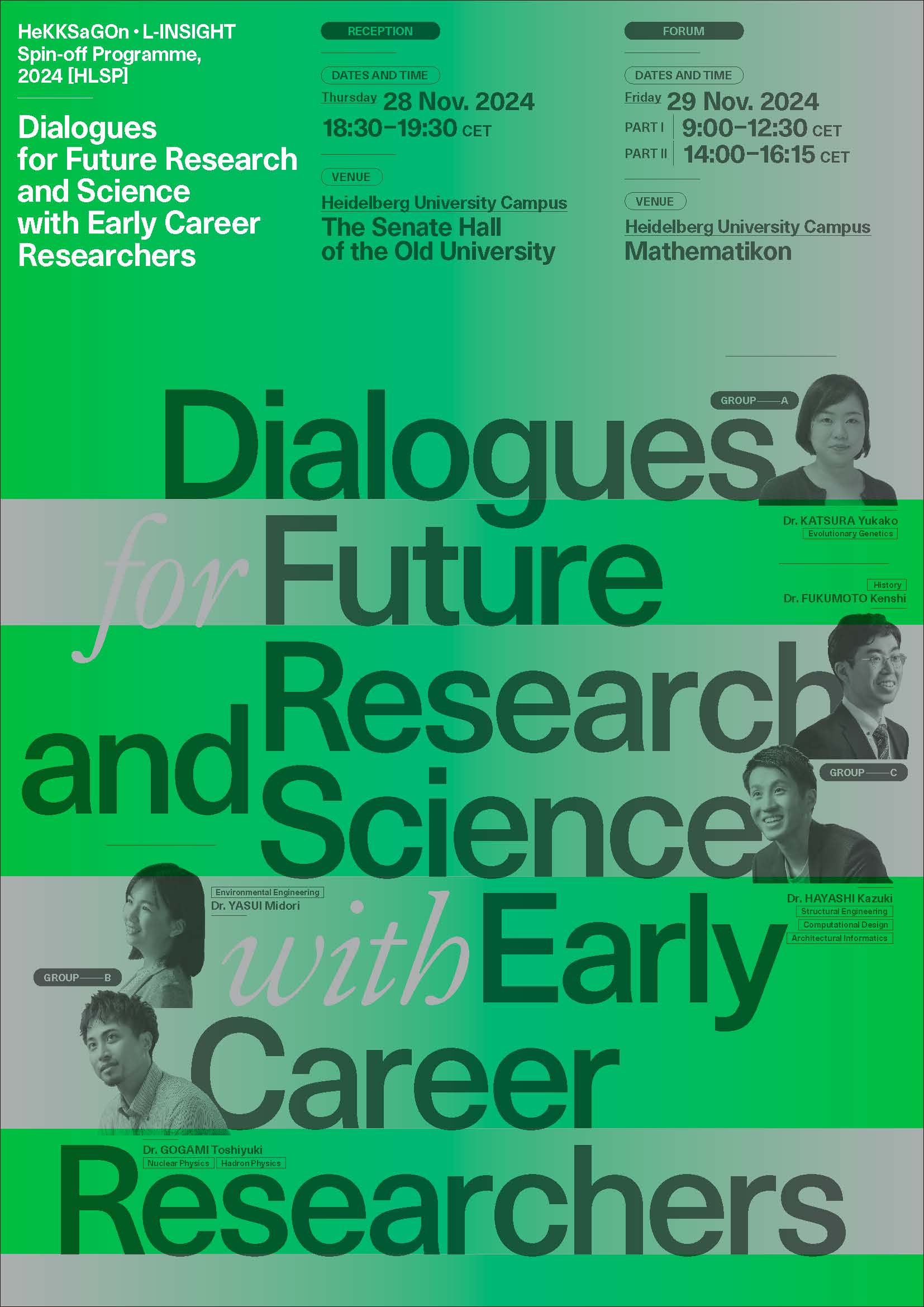
This forum supports the next generation of researchers in forming germinating synergetic forces in cross-cultural interdisciplinary activities.
This initiative has stemmed from the friendly relationship between German and Japanese universities fostered through the HeKKSaGOn (The German-Japanese University Alliance) framework, which is now in its fourth year. This forum consists of 3 dialogues among researchers from Kyoto University (L-INSIGHT fellows, a community of early career researchers), Heidelberg University, Karlsruhe Institute of Technology and Göttingen University. Each group consists of interdisciplinary members who study the same research subject with different approaches.
We also hope that the forum will provide an opportunity for all participants in the audience to form special international and intergenerational connections, which we hope will form the basis for future research excellence.
We cordially invite you to the discussions regarding the topics of your choice. Please sign up now to find your new and future connections through this opportunity.
Reports
Reference
Program
Part II
| 14:00 – 14:50 | Parallel dialogues 2 |
| 14:50 – 15:00 | Moving to the main venue |
| 15:55 – 16:00 | Wrap-ups from each group & General discussion with Guest Scholars
Prof. Dr. Dres. h. c. Eitel Berhard (Institute of Geography, Heidelberg University)
Prof. Dr. Jun Suzuki (Deputy Director, Kyoto University Institution for Integrated Cell-Material Sciences (iCeMS)) |
| 15:55 – 16:00 | Closing
Prof. Dr. Jun Suzuki
Prof. Dr. Dres. h. c. Eitel Berhard |
| 16:00 – 16:15 | Farewell Coffee |
Speakers
Kyoto University
Prof. Fuyuki Ishikawa
Vice-President for Research Support
Prof. Dr. Jun Suzuki
Deputy Director, Kyoto University Institution for Integrated Cell-Material Sciences (iCeMS)
Group C
Dr. FUKUMOTO Kenshi
Keywords: History
Department of Studies on Global Coexistence, Graduate School of Human and Environmental Studies, Kyoto University / Associate Professor
Group B
Dr. GOGAMI Toshiyuki
Keywords: Nuclear Physics / Hadron Physics
Division of Physics and Astronomy, Graduate School of Science, Kyoto University / Assistant Professor
Group C
Dr. HAYASHI Kazuki
Keywords: Structural Engineering / Computational Design / Architectural Informatics
Department of Architecture and Architectural Engineering, Graduate School of Engineering, Kyoto University / Assistant Professor
Group A
Dr. KATSURA Yukako
Keywords: Evolutionary Genetics
Center for Evolutionary Origins of Human Behavior (EHUB), Kyoto University / Assistant Professor
Group B
Dr. YASUI Midori
Keywords: Environmental Engineering
Department of Urban and Environmental Engineering, Graduate School of Engineering, Kyoto University / Assistant Professor
Heidelberg University
Prof. Dr. Karin Schumacher
Vice Rector for Quality Development and Sustainability
Prof. Dr. Dres. h. c. Eitel Berhard
Institute of Geography, Heidelberg University
Group B
Dr. Katharina Brotzmann
Centre for Organismal Studies (COS)
Group B
Dr. Simon Schaub
Institute of Political Science
Group A
Dr. Truc Lam Pham
Institute of Organic Chemistry
Group A
Manuel Hettmansperger
Institute of Sport and Sport Science
Group C
Dr. Maximilian Roca Jungfer
Catalysis Research Laboratory (CaRLa)
University of Göttingen
Group C
Dr. Sarah Iweala
Department of Agricultural Economics and Rural Development
Group A
Dr. Vahid Nasirimarekani
Group Leader of Active Biological Matter Group
MPI (Max Planck Institut)* für Dynamik und Selbstorganisation
Karlsruhe Institute of Technology
Group A
Dr. Islam Khattab
Plant-stress Ecology group – Joseph Gottlieb Kölreuter Institute for Plant Science
Group B
Dr. Katahrina Bleher
Analytical Biochemistry, Institute for Functional Interfaces
Parallel dialogues
Group A. “The Universe and Biological Interface: A Quest for Our Origins and Evolution”
Dr. KATSURA Yukako
Background
We would like to discuss the origin, evolution, and future of life from the various perspective of life science and astrophysics. What is life? Life has a cellular structure that distinguishes itself from the outside world, and is capable of energy metabolism and self-replication. The origin of life on Earth dates back about 4.28 billion years ago. Evolution is a phenomenon in which life repeats birth and death, and changes in phenotypes and genetic information over generations.
Yukako Katsura is an evolutionary geneticist who studies the molecular evolution of sex chromosomes in various organisms. We would like to discuss the evolution and future of life and sexual systems from the perspective of diversity of life.
Anticipated field of researchers
Researchers from various fields who are interested in this topic.
Researchers in fields that connect life sciences (evolutionary biology, biophysics, mathematical biology, astrobiology etc.)
Group B. “Emerging Contaminants and Acceptable Health Risks in Water”
Dr. GOGAMI Toshiyuki / Dr. YASUI Midori
Background
Proper management of food and environment is crucial to ensure the safety of human life and activity. Water-quality standards are determined based on the human health and environmental impacts. Additionally, economic benefits are significant considerations. For instance, nuclear power plants produce a great amount of energy, yet they must release tritium-contained water to the sea. The regulation for the tritium water is evaluated based on risks and benefits. Recently, discussions about the human health and environmental impacts of emerging contaminants such as antibiotic resistant bacteria, microplastic, PFAS, etc. have arisen. Local governments have to determine the water-quality standards based on the local economy and the environment as well as human health risks. We would like to discuss what global standards and acceptable health risks should be and what the researchers’ roles are.
Anticipated field of researchers
Researchers we want to discuss with
– Researchers who interested in this topic
– Researchers in areas of environment, oceanography, agriculture, economy, law, politics, medical, nuclear physics, nuclear engineering, etc.
Group C. “Integration of emerging technologies into a sustainable human society”
Dr. HAYASHI Kazuki / Dr. FUKUMOTO Kenshi
Background
The relationship between humans, technology, and society is dynamic, constantly evolving with the advent of new technologies and the environmental changes they bring. Instead of being limited by our current understanding of technologies, we can align our expertise with the broader context of creating healthier, more peaceful, and joyful living systems. By adopting a holistic perspective on these transitions across our specialized fields and sharing insights, we can explore how, as researchers, we can contribute to the realization of a sustainable human society.
Anticipated field of researchers
We plan to provide historical and engineering approaches to the issue. We sincerely welcome researchers from any background i.e. sociologists, anthropologists, and data scientists, are encouraged to participate, provided they communicate their expertise in a manner accessible to non-specialists, fostering fruitful discussions on the social impacts of the techniques of their interest.
Organizer
Heidelberg University, Karlsruhe Institute of Technology, Göttingen University and Kyoto University
Collaborators
Kyoto University European Center
Contact
Kyoto University Center for Enhancing Next-Generation Research